
Garden
From Garden to Food Garden: Making Space to Grow
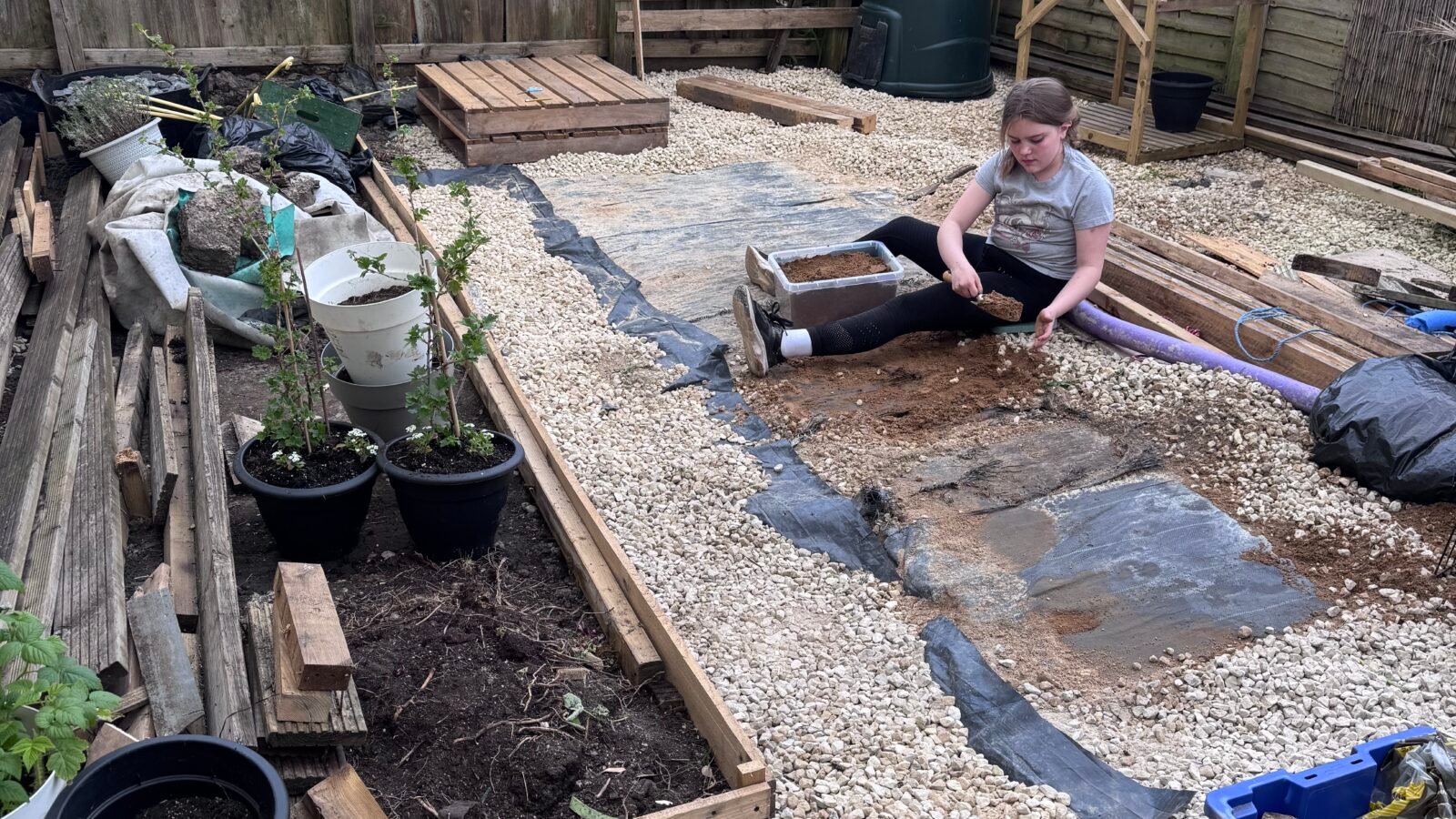
A few weeks ago, we made the decision to stop waiting for more space and start growing food with the garden we already have.
I say we. There may have been a little bit of the royal we involved in the initial declaration. The reality, though, is that once you decide you want to start growing food in a small garden, the enthusiasm is quickly followed by a rather more practical question: where on earth is everything actually going to go?
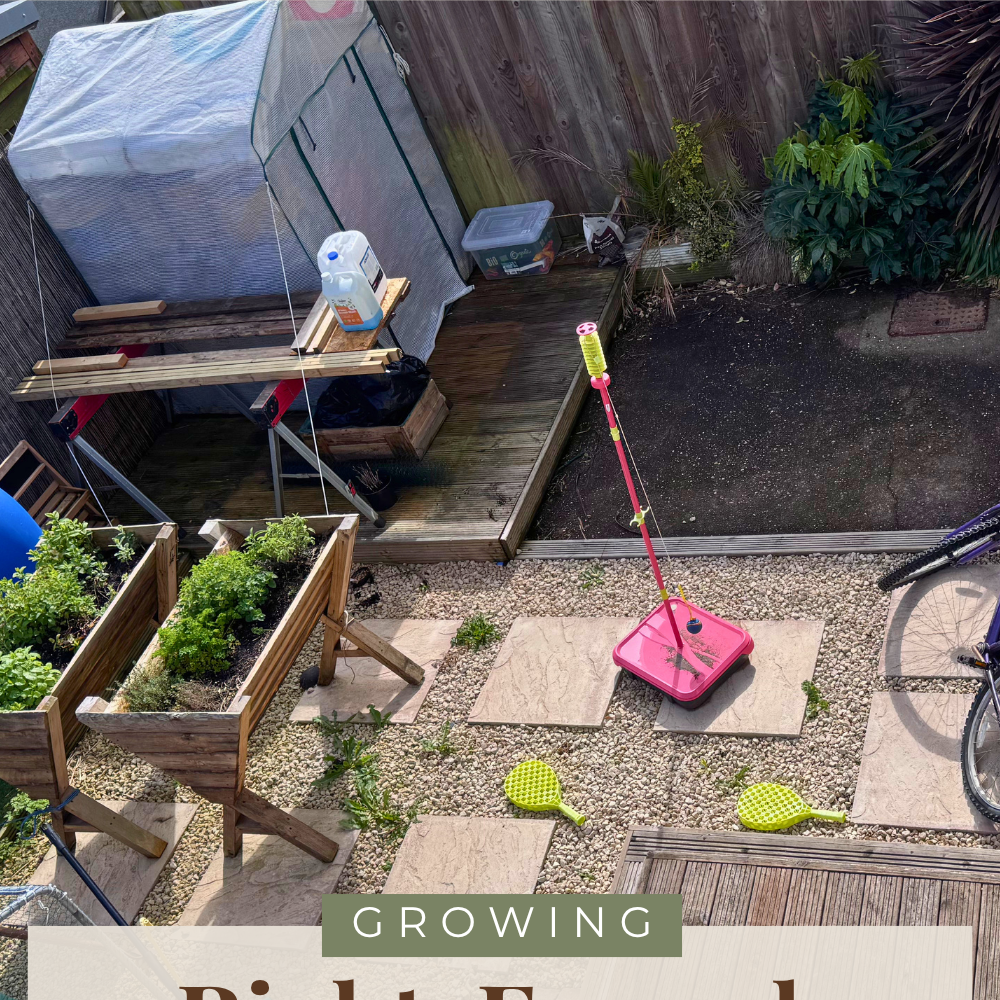
Our garden was never designed as a vegetable garden. It already had decking, gravel, a small greenhouse, some existing plants, bikes, rabbits, washing, paths and all the usual things that a family garden needs to accommodate. We couldn’t simply clear the whole thing and replace it with rows of raised beds, nor did we particularly want to or have the budget too.
What we needed to work out was how to make the space we already had work harder.
Over the last few weeks, that has involved taking things apart, rebuilding them somewhere else and moving what feels like an unreasonable amount of stone around the garden.
It has also taught us that creating a productive garden doesn’t necessarily begin with having more space.
Sometimes it begins with looking at the space differently.
Growing food in a small garden started at the front
The front garden was the obvious place to begin because it required the least upheaval. There was already planting space, it gets a reasonable amount of light and we could start changing things without first dismantling half of the back garden.
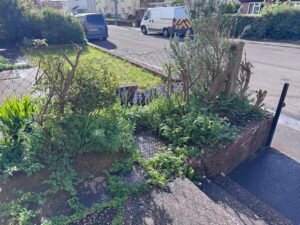
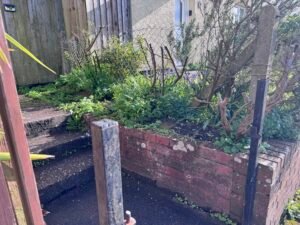
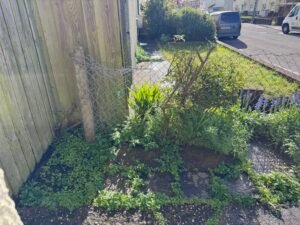
Until now, we’d largely thought of the front as ornamental space. Once growing more food became a priority, that distinction started to feel rather unnecessary. A garden doesn’t have to choose between being attractive and being useful and edible plants certainly don’t all need to live together in something labelled vegetable patch.
We could keep flowers for colour and pollinators while introducing herbs and other edible plants amongst them. Existing containers could be put to better use and the wooden planters we’d made ourselves could move somewhere they would earn their keep
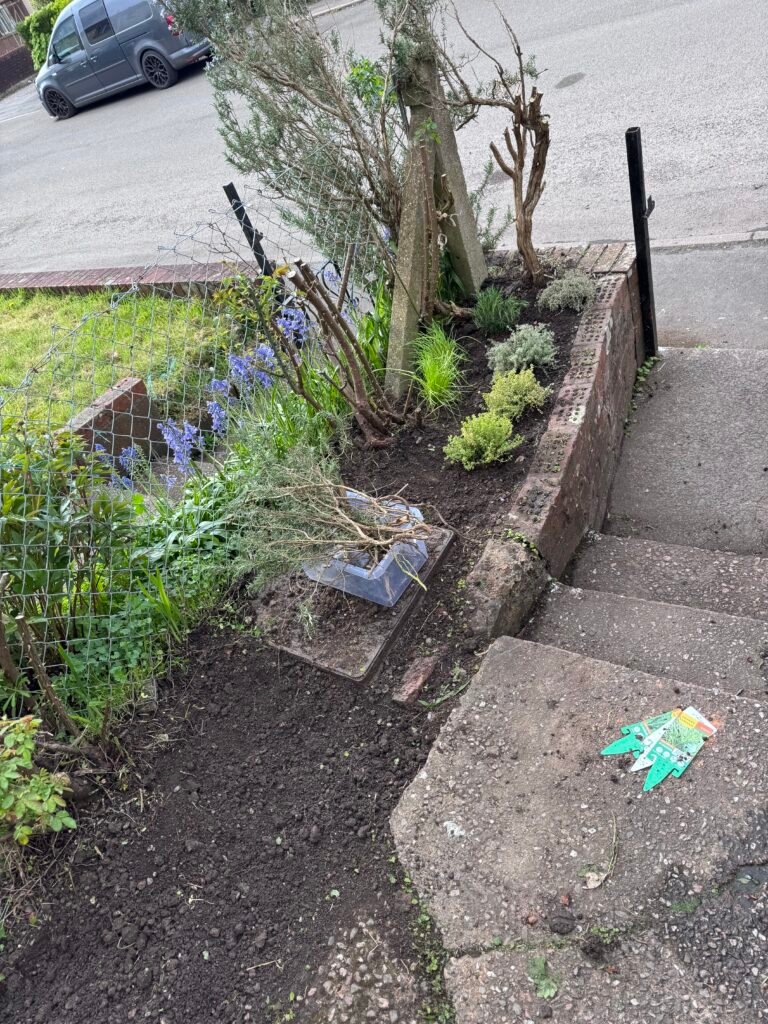
Herbs were an easy place to start. Thyme, rosemary and chives in the side patch with oregano, parlsey, sage, lemon balm and mint in the herb planters. The mint and lemon balm were given pots of their own inside the planters because I have learnt the hard way about giving either of those unrestricted access to the garden.
Calendula and yarrow were part of the plan too. from the drain up towards the fence and gate into the back garden. Not just as pollinators but also as medicinal herbs for salves, balms and the all important herbal tea.
The aim has never been to strip every flower out and replace it with vegetables. If anything, the more we’ve learned about pollinators and growing food, the more important those flowers have become.
The front garden was a relatively small change but it shifted something important in the way we were thinking.
Instead of asking, “Where could we fit a vegetable garden?”, we started asking, “Where could we grow something edible?”
Those are two very different questions.
Then attention turned to the back garden
Once we’d started seeing potential growing spaces, there was one particular area in the back garden that became increasingly difficult to ignore.
The decking underneath the window.
It occupied a considerable amount of ground and unlike the main area of decking, wasn’t really giving us anything particularly useful in return. If we were serious about creating more growing space, it seemed an obvious candidate.
So 17 April, was DR Day…. Decking Removal Day!
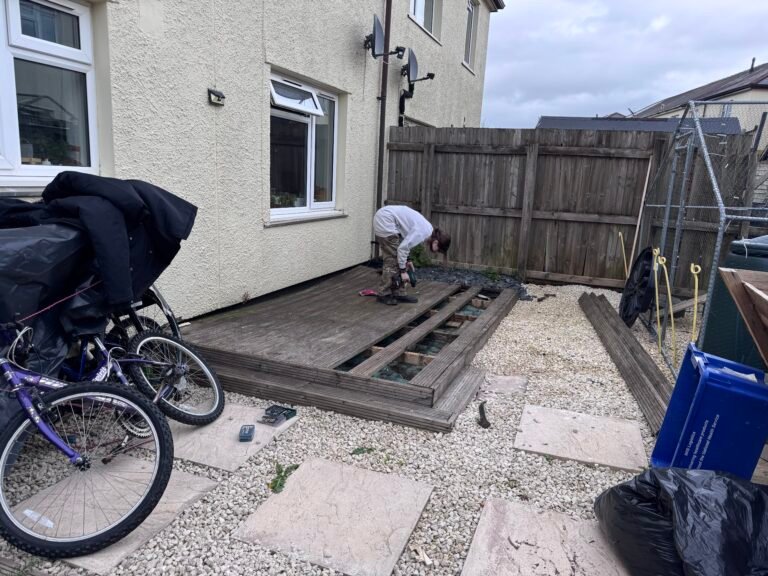
Removing the decking was a far harder job than it first looked. With rusty screws that had made themselves well and truly at home in the wood, it was hard going but thankfully the crowbar and I became the best of friends!
Then there was the gravel. A lot of gravel.
Much of the garden was already covered in stone and as we wanted to reuse as much as possible for the new pathways, it wasn’t something we wanted to get rid of. The problem was rather more practical: in a garden this size, there was nowhere to put it while we worked.
To clear one area, the gravel had to be moved to another. Then, when we needed to work there, it had to move again. Bags, buckets and piles of stone seemed to migrate around the garden depending on which bit we were trying to tackle next.
It wasn’t because the plan kept changing. Quite the opposite. By this time we knew where we wanted everything to end up; we simply didn’t have enough spare space to get from before to after without repeatedly moving everything in between.
By this point, I was becoming less of a gardener and more the manager of a very inefficient stone-relocation company!
The plan was simple. The logistics were not.
One of the things I hadn’t really considered when we started was how much harder it is to transform a small garden when there isn’t a spare corner available to use as a temporary dumping ground.
Every part of our garden already had something in it or needed to remain accessible. Timber removed from the decking had to be stored somewhere while we reused it. Plants needed somewhere safe to wait. Bags of compost and soil needed a temporary home and every time we cleared another section, whatever had been sitting there needed moving first.
The photographs probably explain it better than I ever could. At various points it looks as though we’ve emptied the contents of several gardens into one very small space.
But there was a method behind the chaos.
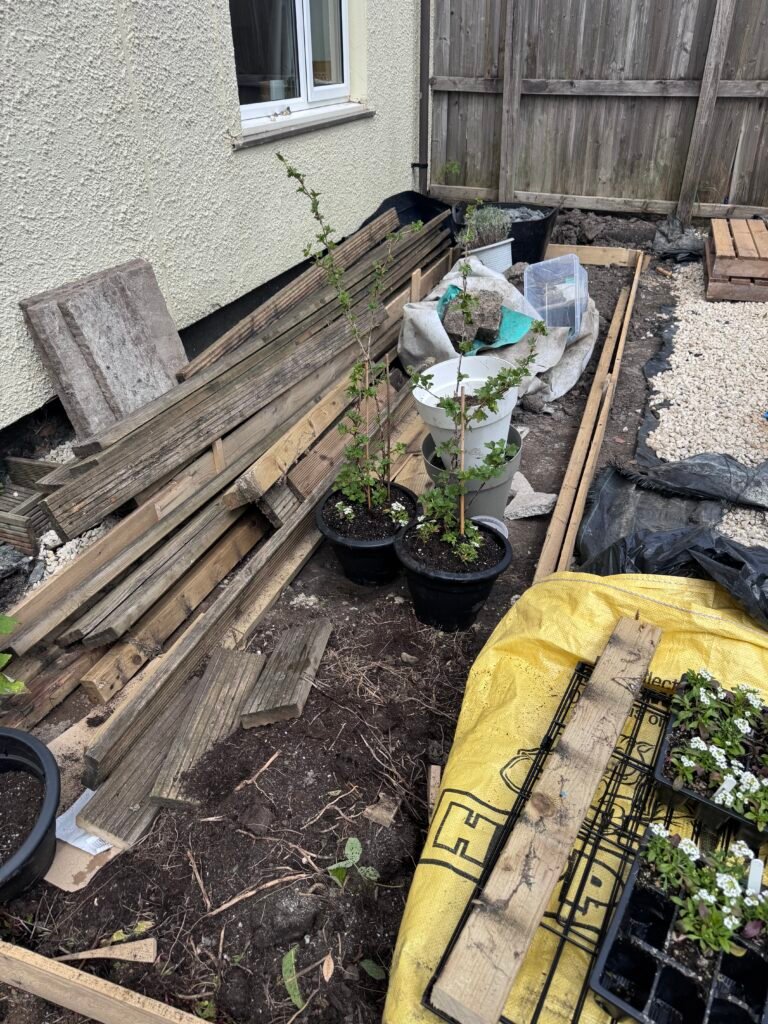
he decking was taken up to create growing space. Some of that timber would be reused. Gravel was being retained for the pathways, while access around the beds, house and garden still needed to remain practical. At the same time, the existing decking was being extended so that the rabbit run could sit properly on it.
Basically working in a small garden meant doing everything in stages. We couldn’t clear the entire site, build everything and then put it all back. We had to create one bit of space before we could tackle the next.
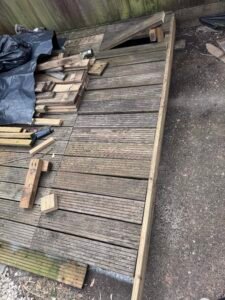
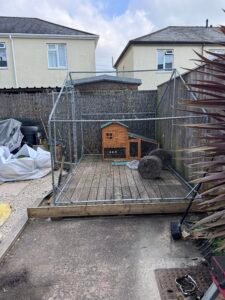
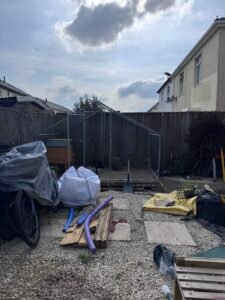
Extending the remaining decking meant more measuring, more timber but it also meant that one area of the garden could continue serving family life without taking space away from the food-growing areas.
This is one of those things that is easy to overlook when looking at somebody else’s finished kitchen garden online. Their garden only has to solve their problems.
Ours has to solve ours.
And yours only has to solve yours.
Reusing what we already had
This also couldn’t become a project where everything existing was ripped out and replaced with expensive new materials as we just didn’t have the budget, actually more acurate description would be no budget!
Part of the point of growing more of our own food is making better use of what we already have.
The gravel around the garden could become pathways. Timber could be reused where possible. The planters we’d already made could move somewhere more productive and the little greenhouse was way past it’s due date and just had to go.
Water became part of the planning too.
More plants inevitably means more watering, so suddenly the downpipes and potential position of a water butt became considerably more interesting than they had ever been before. If rain is going to fall on the house anyway, collecting some of it for the garden makes far more sense than paying to replace it from the tap later.
None of these changes is particularly dramatic on its own. Together, though, they begin turning an ordinary family garden into something much more productive.
This was not particularly photogenic
There is a stage in almost every project where the original version has been dismantled but the new version hasn’t quite appeared yet.
Our garden spent a fair amount of time there.
Looking back through the photographs from the last few weeks, it is easy to see how much happened between before and after. There were piles of timber, bags of compost, pots waiting for permanent homes and sections of garden that seemed to have been half-finished simultaneously.
The physical work also caught up with us. Digging, lifting decking, moving timber, shovelling gravel and then occasionally moving that same gravel somewhere else and then back to where it was is rather more demanding than scrolling through pictures of vegetable gardens and deciding you’d quite like one.
By the beginning of May, my body was making its views on the matter fairly clear.
Then the rain arrived and stopped play anyway.
Perhaps it had seen enough.
What helped was recognising that the untidy wasn’t evidence that anything had gone wrong. We were changing a garden while still living in it and there was always going to be a period when it looked worse before it looked better.
Then it started to look like somewhere we could actually grow food
Toward the end of the first few days of May, things finally started coming together.
Paths appeared where piles of gravel had been. Beds had actual edges. The rabbit area had a proper plan, herbs were finding their homes and the garden was beginning to look less like a building site.
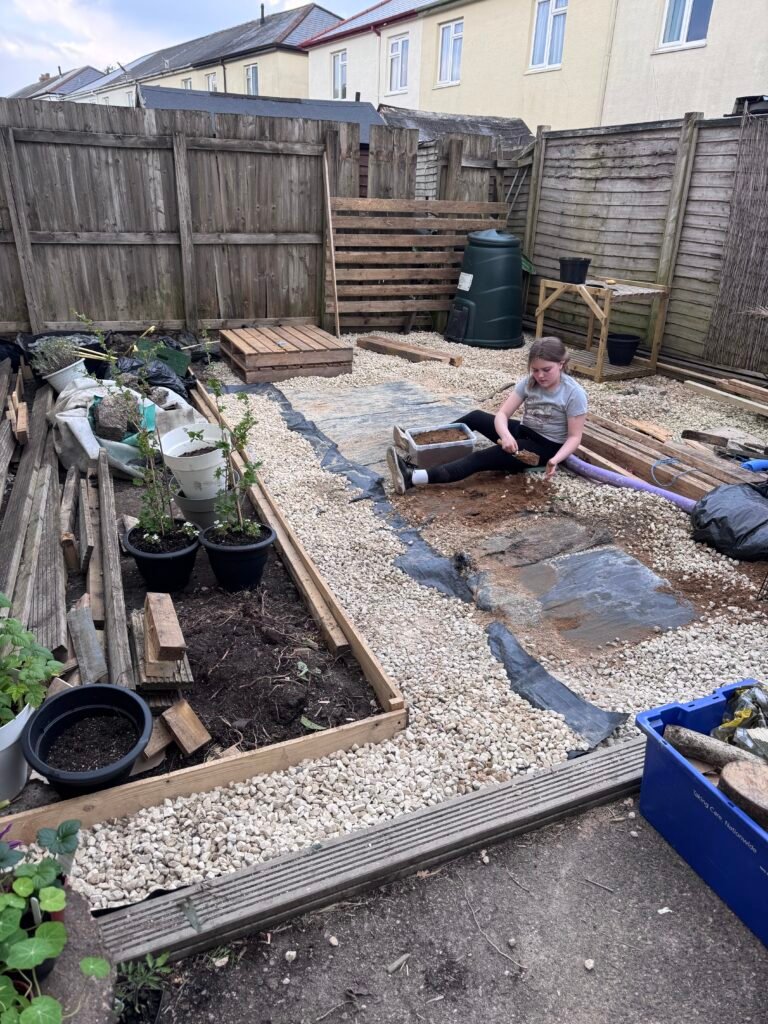
There were also plants waiting.
Tomatoes, strawberries, beans, herbs and seedlings have an excellent way of making an unfinished vegetable bed feel considerably more urgent. Once they’re sitting there in their pots, they quietly remind you that at some point they would rather like somewhere to grow.
By 4 May, some of them finally had it.
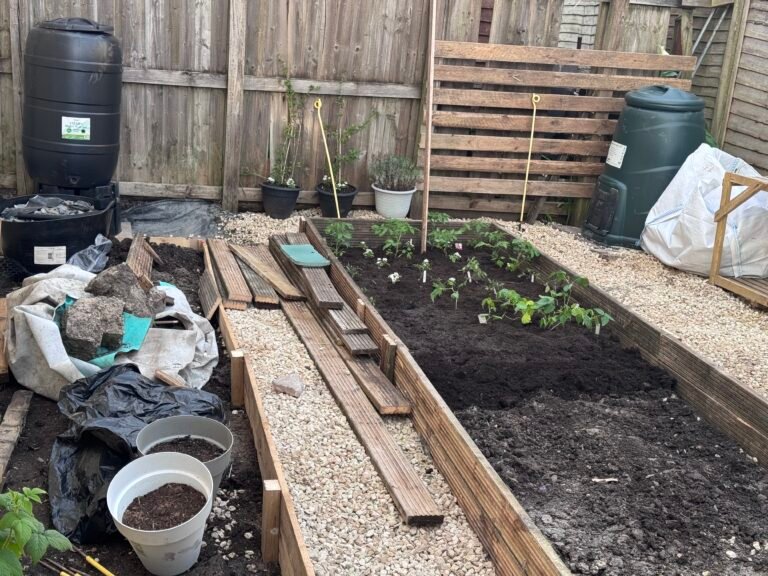
Seeing food physically growing in an area that had looked completely different only a few weeks before was so exciting and a bit emotional.
We still weren’t looking at a huge vegetable garden. Nothing about the dimensions of the property had changed and it certainly wasn’t suddenly going to provide everything our family eats.
But we’d created growing space where we previously thought there wasn’t any.
You don’t need to transform the whole garden before you begin
If you’ve been thinking about growing food but your garden doesn’t look anything like the vegetable gardens you see online, ours didn’t either.
Perhaps your space also has to accommodate children, pets, washing, bikes, bins or somewhere to sit. Maybe you only have one sunny border, a narrow side garden or a few containers near the back door.
That doesn’t automatically make it unsuitable.
What has helped us most is letting go of the idea that we need to transform everything before anything worthwhile can happen. Starting with the front garden gave us a manageable first project and taught us to look for productive space elsewhere.
You could begin with herbs in a planter, strawberries amongst existing flowers or climbing beans growing upwards rather than taking over precious ground. Even noticing where the sun falls throughout the day is useful because it starts turning an ordinary garden into a space you’re learning to understand.
The goal doesn’t have to be total self-sufficiency.
It can simply be more than you were growing yesterday.
What these first few weeks have taught us
Perhaps the biggest lesson so far is that growing food in a small garden is less about squeezing vegetables into every available corner and more about making thoughtful use of the whole space.
Some areas need to grow food.
Others need to provide access, collect water, accommodate animals or allow ordinary family life to continue.
Getting those things to work together takes a little trial and error, and I’m now far less worried about changing the plan when something doesn’t quite work.
We haven’t finished the garden yet. There are still things to plant, areas to improve and knowing our luck, probably several tonnes of stone somewhere waiting to be moved again.
But when we look outside now, we don’t see quite so many limitations.
A few weeks ago, the question was whether we could grow a meaningful amount of food in this garden at all.
Now we’re beginning to ask a much more exciting one.
How much can we actually grow?
You may also like
Garden
Right. Enough… Growing Our Own Food.
I’m done waiting for more land. This is the beginning of our journey growing our own food, using the small family garden and space…
Read more →
Garden
The Last of the Spring Blooms: Afternoon Garden Gatherings and Thrifted Treasures
I wandered out into the garden to gather what’s likely the final flush of spring colour, the last of the spring blooms. The bluebells…
Read more →
Growing
Our First Strawberries: A Delicious, Fresh Beginning
We don’t have a big garden, yet we have just picked our first strawberries. This small moment has encouraged us to rethink how we…
Read more →